
Apparently, I named my boys right — and I say that because of one specific Bible verse.
Joel the brother of Nathan (1 Chronicles 11:38)
Back in April 2000 and November 2001, I wasn’t thinking of this verse as I picked out boy names for my tiny sons. I don’t even know that I was aware of it, which might be odd since I have been a faithful church attender for all of my life. Then again, 1 Chronicles 11:38 seems like a pretty obscure verse.
The very first time I remember running across the verse, my boys might have been 4 and 2, but it’s hard to remember with certainty. I think Julia had already been born, so that would mean Nathan was at least 2 years old. The main thing I remember is how the verse made me laugh out loud at the strange absurdity of the coincidence.
Over the years, I have encountered this verse many times. It just so happened that yesterday it was in my daily Bible reading plan. Once again I marveled at it, even though 1st Chronicles chapter 11 isn’t super exciting to read.
Essentially, in the previous chapter in 1st Chronicles, King Saul dies. Now David is preparing to step into his role as King over Israel and his first order of business is to march to Jerusalem to overthrow the Jebusites who are inhabiting that city. The rest of the chapter, from verse 11 onward, is essentially the naming of David’s mighty warriors. It’s a long list that seems to go on and on until you wonder if you’ll ever reach the end of it.
And in the middle of all those names, buried in verse 38 (just after Hezro the Carmelite, Naarai son of Ezbai and immediately before Mibhar son of Hagri) you find the words “Joel the brother of Nathan.”
Once again, the words brought a smile to my face.
For some reason, I took a screenshot of that verse and sent it to my boys, assuring them that I had indeed chosen the correct names for them both.
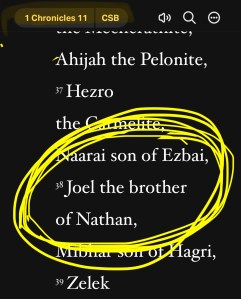
My Nathan very quickly responded back, “I wonder what Nathan was doing — since Joel was a mighty warrior.”
I guess that’s a fair question. If Joel was one of David’s mighty men, then what was Nathan doing? Furthermore, most of the mighty warriors were identified as being either the son of someone or being from a particular location. Why then was Joel identified by his brother? And lastly, why did I never think to ask these questions?
So I looked it up. It turns out that most Bible scholars believe that this Nathan, who was the brother of Joel, was also the same man as the prophet Nathan who later confronts David about his adulterous affair with Bathsheba. (Now how had I never made that connection before?! Indeed I had not because it was news to me!)
I quickly wrote another text my boys.
“Scholars believe this Nathan is the same as the prophet who later confront King David about Bathsheba. So while Joel was a mighty warrior, his brother Nathan was a prophet who faithfully shared important messages from God to the king. Same family. Very different jobs. Both served the king.” Then I added, “The take away is that we are all part of the family of God, with different talents, skills, and purposes, yet all of us serve the King of Kings.” I finished it off with these words: “And that’s your Bible lesson for today.”
But the truth was it was also a Bible lesson for me too.
You see, I’ve been worked up over the SBC’s Truth and Unity amendment — the one about roles of women within the church.
I mentioned earlier that I have been going to church practically all of my life, but the truth is that those churches have by and large been SBC churches. In fact, I come from a family that includes SBC preachers, international missionaries, seminary professors, deacons, SS teachers, and choir members. I’m about as much of a “good Baptist girl” as you will ever come across.
And yet, this SBC amendment thing got me all kind of sideways. I tell you I was some kind of worked up over it. At one point, my husband Jon said, “Why has this upset you so much? I really don’t understand. Have you changed your position on women preachers?”
I have to admit that I needed to sit with it for a long, long time. Why was I so upset? What about this amendment had me in such a state? I asked myself a lot of questions. I read back over the scriptures. I read blog posts, news articles, and opinions on just about every social media account that came up in my searches for information.
Right here I want to pause and say that my goal in this post is not to debate the ins and outs of the SBC amendment or whether or not it is Biblical for women to preach. There’s already a lot of people with loud arguments on both sides of the debate. If I learned anything this past week, I learned this : All of them are sincere. All of them have scriptures and examples and reasons to back up their position. All of them love Jesus.
Besides, my own internal conflict oddly doesn’t have to do very much at all with the sorts of roles women are “allowed” to serve in an SBC church.
It has more to do what seems to be, as my dad would often say, “majoring on the minors.”
The truth is that each person in the family of God has an important role to play in advancing God’s kingdom. Joel was a mighty warrior. Nathan a prophet. They both served the same earthly king (and I’m going to step out here and say very likely the same God). Different jobs; same goal.
Within the family of believers, each of us has a job. Some preach from a pulpit or lead worship. There a teachers, writers, artists, caregivers, counselors, book keepers, nurses, soldiers, and even just loving friends. The ways God uses people and the callings He puts upon our lives are as vast as the people who inhabit the planet.
Platforms and influence may be big or small or something in between. And yet all of us who follow Jesus have been called to do something. Those callings don’t come from our church or denomination or any person. Our callings come directly from God.
So back to my son’s question: What was Nathan doing? He was busy doing what God called him to do.
Why does that matter? Because our faithfulness to doing what God has called us to do always matters.
I probably will never feel comfortable attending a church with a woman as the head pastor. But am I going to point fingers at churches that do? No. I can’t. And here’s why:
Debating and arguing over who gets to share God with someone else and how they are allowed to share that message does nothing to share God’s love with a world that desperately just needs to know more about Him.
After all, as the Apostle Paul once wrote, “But what does it matter? The important thing is that in every way, whether from false motives or true, Christ is preached. And because of this I rejoice.” (Philippians 1:18)
At least, that’s my two cents. And if this makes me wrong, then maybe I’m not as much of a good Baptist girl as I once thought.


 Paige's Pencil